
One of running’s coolest finishes. Michigan International Speedway in Brooklyn, Michigan.
One of running’s coolest finishes. Michigan International Speedway in Brooklyn, Michigan.

“This past summer has been very disappointing for me, because—even though I didn’t have any huge bombs—I didn’t feel that I was reaching my potential, and I struggled with some injury. Overall, I was pretty much just disappointed every time I touched the track in races. So it was a hard summer. But this fall has been really good, and I think one of the big things that’s helped me was working with a sports psychologist. She’s helped me to focus on the right things and enjoy what I’m doing and love myself. I don’t have any races to really show that I’m out of that yet, but I don’t really need to prove it to myself because I know—I can tell that I’m happier and I’m enjoying my training and things are going well. I feel full of hope.”
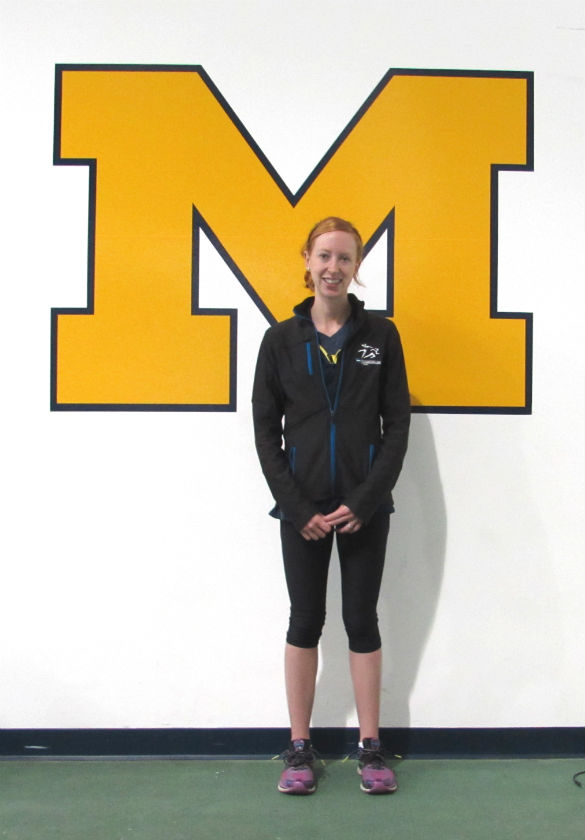
“My most frustrating running moment was my junior year at Hillsdale [College]. I had suffered a series of three stress fractures between my freshman and sophomore year, so I was out a year of racing. I came back really slowly. My junior year in cross-country, I was still running pretty slow. Hadn’t PR’d in two years. I had raced at our home course—ran the worst I ever finished on our team. And I just felt like my running career was going nowhere. … Immediately getting through that, my coach decided to have me do more of a fun race, a shorter one. Get out there and just feel the point of racing again: to enjoy it. I ended up running pretty well, felt a little bit more competitive, came back three weeks later and finally PR’d by 45 seconds in the 6K. … Since that point, it’s been kind of a steady progression where I keep putting the work in, and I am seeing the results. That’s keeping me motivated. … We do have a tradition at Hillsdale College. It’s called the Cider Mill Run. Our coach [was] Wild Bill Lundberg, who is just a crazy coach, and what he has us do is we run for a couple miles in the woods, and we pick up all the glass bottles we can find. He’s got a pedestal that we’re supposed to put them on, and we’ll get rocks and take turns chucking the rocks. And whoever breaks the bottle gets a free pair of shoes. So this is what we do every year as our fun run the week before regionals.”

“One of my biggest setbacks in high school would be having a stress fracture from my last season of track. This was going into senior season, big goals ahead. I had already committed to Michigan, but I still had times I wanted to get. … I had a really good indoor season, then two meets into the outdoor season, my shins just completely gave out on me. So I got an MRI, found out I had two stress fractures. So that kinda put a damper on training right away. I got to the Golden Triangle Meet at Saline, kinda like a state meet preview, and I got to run the 8 [800 meters] there—it was the last thing I did before taking a month-and-a-half off. So I spent a month-and-a-half in the pool. I’d get up in the morning and swim with the swim team. Then after school, either elliptical or bike and then get back in the pool. I did that all the way up to the regional meet, so I got to regionals, and I hadn’t been on a track up until like the day before, and that was just a couple of strides. So I got through that, qualified with a time, made it to the state meet. My coach from there had me doing workouts every once in a while. With 200 meters left in the state meet race though, I felt something shift in my shin, and it just gave out on me. So I went from being third with like 250 to go, to dead last. I got a pity clap coming in the homestretch—probably one of the worst moments ever. … So that was my transition into collegiate running.
“I got back for cross-country [at Michigan], and then same thing: double stress fractures again right before indoor started, except it was both legs this time. I kinda rushed back into training because I was really eager about starting college running. I felt like I had a little bit of ground to make up. … It was one of those things where you got to know the pool, the bike and the Ann Arbor swim club that comes in between 11 and 1. I knew their times, they knew me. We were on a first-name basis in the diving well. So that was one of those things where you didn’t really get to see the team very much freshman year, which was difficult. … But with maybe two months left in outdoor, I started training again, so I got to do my base mileage, and the upperclassmen girls were really good about bringing me back. I got to race one meet at the end of the season. It was just an 800, and I literally had not touched a track since doing a race [simulation] 600 indoor back in December. So [Coach] McGuire came up to me before, and in terms of life advice, McGuire is a pretty quiet guy, very few words. And the only thing he said to me was, ‘If you go out and try to lead this in a 60 or 61, I will run out onto the lane and tackle you’ and walked away. So I pretty much went out, sat back the first lap and then picked up the second lap again. Took his advice, and it went really well. I think I got second in the heat and broke my high school PR. So I went 2:14-low, and I was really happy with it for a first race back.”
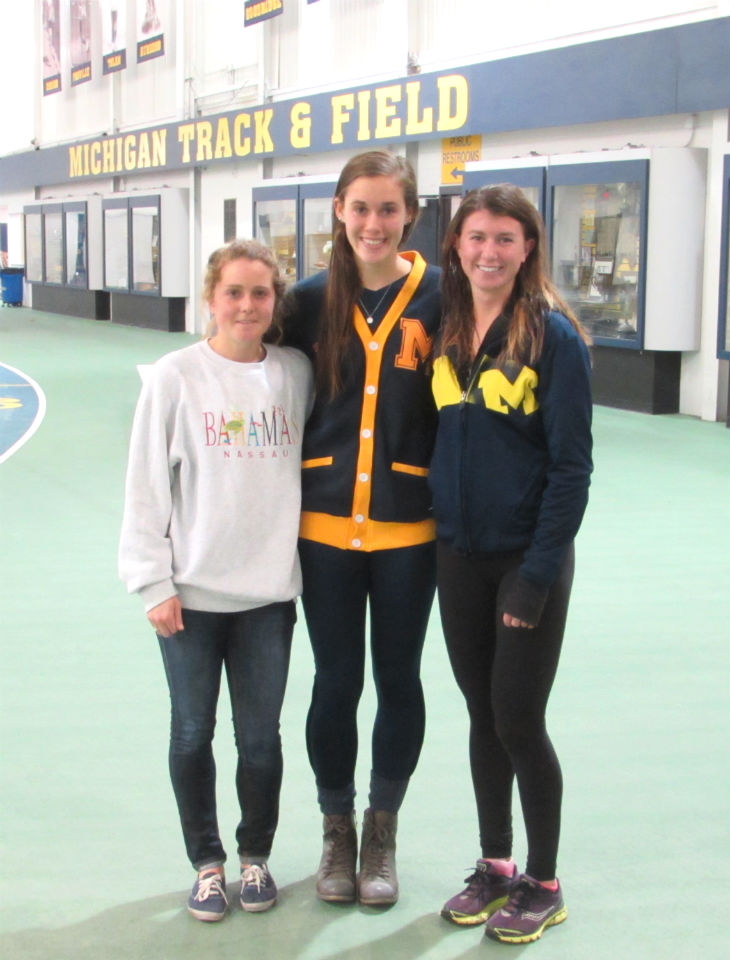
Right: “I want to do a road mile. I want to break 16 in the 5K. I have wanted to break 17 in the 5K for a long time for cross-country, and I did it in my 6K on Sunday. I was so happy when I saw the time. Because that was my high school PR [17:00.2]. And we don’t run 5K very often [in college]. For so long I was like, ‘I can’t break my high school time.’ But I finally did it.”
“Talk about Coach McGuire. What has he taught you that you’ll take with you beyond Michigan?”
Right: “Tough love, don’t feel sorry for yourself, and just work hard. … There’s a level of accountability on the team, and so whenever there’s a period of no leadership and no seniors making sure everyone’s running enough miles, then the team’s way worse for a few years. … He really lets us create our own culture. He knows that even if he tried to create our culture, he couldn’t. You know what I mean? He’s one person, there’s 30 of us.”
Center: “He’s not really that involved in every single aspect of our training. He doesn’t tell us how many miles to run—it’s up to us. We adjust it to how we feel and how our bodies are reacting to it. … [Coach McGuire] is old enough and wise enough to know that this is the best way it works.”
 Hooray Run