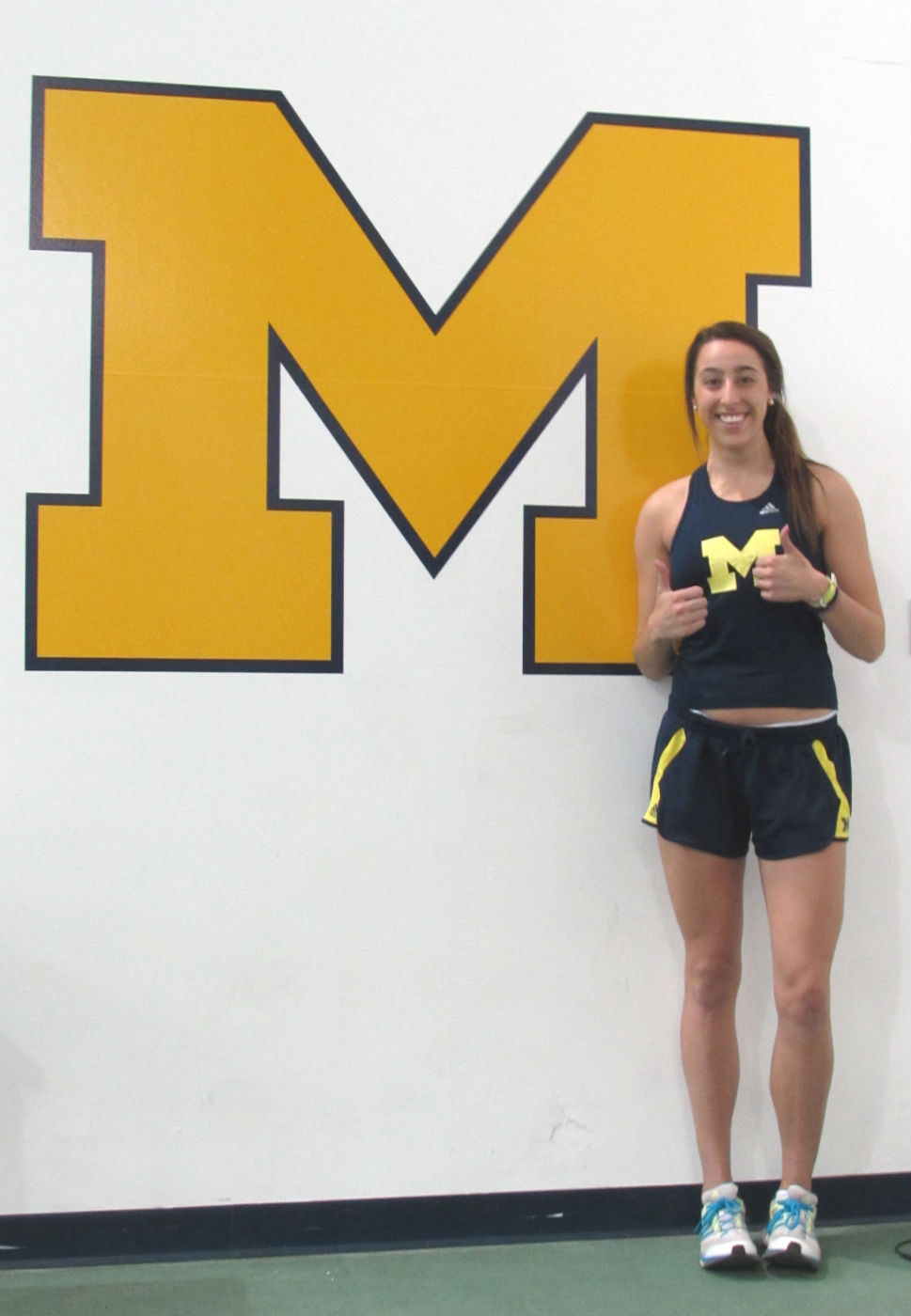
“I’m an 800 runner, and long-distance running is not my thing. But I think doing a marathon on every continent would be amazing. I love traveling and meeting new people. It’s definitely something I want to do—it’d be cool to incorporate running to traveling. And then racing a race in each state, whether that’s collegiately and traveling for that, or post-grad. It’d be cool to do an any-distance-in-any-state type of thing. So anywhere from 5K to 10K, half marathon to full [marathon].”
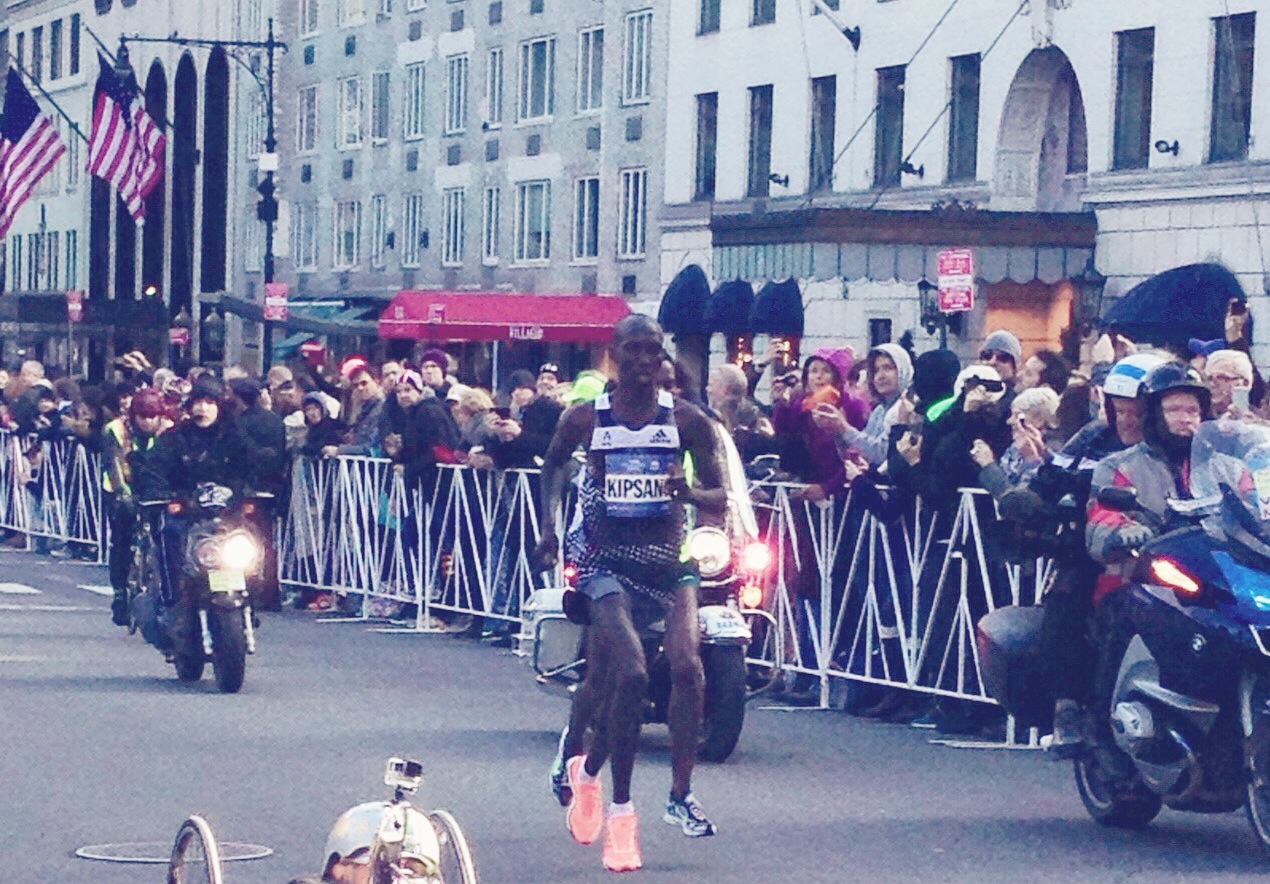
Wilson Kipsang leads the men’s race around mile 25 on Sunday.
Photos by Bethany Rogers
Those racing the 2014TCS New York City Marathonfaced difficult wind gusts, and over 50,000 took on the blustery conditions.
The wind quieted talks of course-record attempts, but Kenya’s Wilson Kipsang (2:10:59) and Mary Keitany (2:25:07) represented their country well with first-place finishes.
Men: Kipsang Has $600,000 Payday
Kipsang won in 2:10:59 in his NYC Marathon debut. He fought off Ethiopia’s Lelisa Desisa (2:11:06) for the $100,000 victory prize, also claiming theWorld Marathon Majorstitle. The 32-year-old Kipsang takes home an additional $500,000 for the WMM triumph.
Kipsang, who is sponsored by adidas, was celebrated by adidas Running:
Kipsang has a 2:03:23 marathon PR to his name, a then-world record run in Berlin in 2013. He won the London Marathon in 2012 and 2014, and he ran 1:01:02 to win the 2013 NYC Half Marathon. Kipsang is a menace to opponents on the roads.
Here are the top 10 men from Sunday:
1. Wilson Kipsang (KEN) — 2:10:59
2. Lelisa Desisa (ETH) — 2:11:06
3. Gebre Gebremariam (ETH) — 2:12:13
4. Meb Keflezighi (USA) — 2:13:18
5. Stephen Kiprotich (UGA) — 2:13:25
6. Geoffrey Mutai (KEN) — 2:13:44
7. Masato Imai (JPN) — 2:14:36
8. Peter Cheruiyot Kirui (KEN) — 2:14:51
9. Ryan Vail (USA) — 2:15:08
10. Nick Arciniaga (USA) — 2:15:39
The American men put three in the top 10, a nice showing for USA distance running. Meb won NYC in 2009 and the Boston Marathon earlier this year, and he led the American charge with a fourth-place finish on Sunday.
Meb, Vail and Arciniaga were the three Americans in the top 10, and here are the next five USA finishers:
Keitany defeated fellow Kenyan Jemima Sumgong by three seconds, crossing the line in 2:25:07. The marathon’s official Twitter account captured Keitany’s win:
Prior to this victory, the 32-year-old Keitany posted back-to-back wins at the London Marathon (2011, 2012). She holds a marathon PR of 2:18:37—the third-fastest woman ever.
Here are the top 10 women from Sunday:
1. Mary Keitany (KEN) — 2:25:07
2. Jemima Sumgong (KEN) — 2:25:10
3. Sara Moreira (POR) — 2:26:00
4. Jelena Prokopcuka (LAT) — 2:26:15
5. Desiree Linden (USA) — 2:28:11
6. Rkia El Moukim (MAR) — 2:28:12
7. Firehiwot Dado (ETH) — 2:28:36
8. Valeria Straneo (ITA) — 2:29:24
9. Buzunesh Deba (ETH) — 2:31:40
10. Annie Bersagel (USA) — 2:33:02
Linden, who runs for Hansons-Brooks, gutted out a top-five finish to lead the Americans. Brooks Running congratulated Linden and Vail for their Sunday performances:
This past summer, I ran my first full marathon in Charlevoix, a small town in northern Michigan. Now, I must admit that I took a rather laid-back approach to the whole thing at first. But believe it or not, talking about running 26.2 is quite a bit easier than running 26.2.
So I went through the extensive training. When you’re training alongside your dad who has not missed a single day of running for the past 29 years, this training involves no rest days.
It was definitely taxing—physically, mentally, you name it. There would be 90-degree days in the beginning of June that didn’t necessarily make me want to go for a 16-mile run. But you have to do it. You have to put in the effort and the time if you want to reap the payoff.
And then race day comes along, and you realize that all of those crazy weeks of training have come down to this. It’s kind of daunting, kind of super cool, kind of unnerving.
So there we are at the start; and soon we’re off. The first five miles fly by, and forgetting the fact that I have 21 more to go, I start to think, “Wow, this is great. I love this. Man, I feel alive.”
So naturally, I surge forward and enjoy the next five miles or so. And then after a little while, I stop enjoying myself. Now, the Charlevoix Marathon happens to be an out-and-back course, which means that when you hit the halfway mark, you then turn back and retrace your steps for the remaining 13.1.
Photo by Linda Rogers // Bethany and her dad, Randy Rogers, all smiles after 26.2.
Needless to say, I had been a bit too eager during the first half of the race and could not wrap my head around the fact that I had to do all of it again. So for the next few miles, I was a mess.
I felt tired; I felt like I was in over my head; I actually entertained the thought of what would happen if I collapsed and was stranded out on the course. I guess when you have that much time to think, your imagination does all sorts of fun things.
But then, shortly after mile 17, I came over this hill (barely), and there in front of me was perhaps the most beautiful panoramic view of Lake Michigan I had ever laid eyes on. Gosh, if I had had any extra breath, it would have taken my breath away.
You see, I was feeling weak at that point. I was feeling really weak. But at that moment, I just felt a rush of new strength; and I think that’s what has always been so enthralling to me about running—the sweet paradox of it all.
Running can totally strip you of your strength only to reveal that there is even more there than you had originally conceived, that amid the great weakness rests undeniable power—to press on, to push through, to move forward, to go on the strength that ordinarily doesn’t seem necessary.
And so you do. In the case of my marathon, I pushed through the last nine miles or so. In the case of an everyday run, it might be a matter of pushing through a 10-minute rough patch or those last three miles. Whatever the case may be, you do it. And you grow.
How sweet to experience the strength that only weakness can make known.



 Hooray Run